A “tested” badge is worth exactly what its issuer will let you check. Some badges come from an outside body that examines a named product against published criteria and keeps a public list. Others are a sentence the seller wrote. This note explains how to tell them apart, what the best-known programs really examine, and what none of them can tell you.
The legal baseline: what every maker must already do
In the United States, dietary supplements are not approved by FDA before they are sold. FDA says it “does not have the authority to approve dietary supplements before they are marketed” and that manufacturers and distributors carry the initial responsibility for safety; in general, the agency’s enforcement comes after products reach the market.3 NCCIH says the same, with narrow exceptions for new ingredients.4
What does exist is a manufacturing rule. 21 CFR Part 111, the current Good Manufacturing Practice (GMP) rule, applies to anyone who manufactures, packages, labels or holds a dietary supplement, including imported products.1,2 It requires a company to set specifications for identity, purity, strength, composition and limits on contaminants; to verify the identity of each dietary ingredient with at least one appropriate test (unless FDA grants an exemption); and to verify that finished batches meet its specifications, either by testing every batch or a subset chosen with a sound statistical sampling plan.1
Two things follow. A maker who says it tests its products is describing what the law already expects, and the tests are its own or those of a lab it hired. And a line such as “made in a GMP-compliant facility” is that same baseline restated. Unless it names an outside auditor and a certificate you can look up, it is the seller’s own statement.
“GMP” is the legal floor, not a seal. The useful question is not “did the company test?” but “did someone with no stake in the sale check this exact product, and can I look that up?”
The main independent programs, one by one
These descriptions come from each program’s own pages where our tools could open them, read on September 25, 2026. The live explanatory pages at usp.org, quality-supplements.org and nsf.org refused automated requests, so for USP Verified and NSF Contents Certified we read Internet Archive copies of those pages (captured December 2025 to January 2026) and also lean on independent trade sources and NSF’s own directory. Check the current program page before relying on a fine detail.
USP Verified Mark
Run by the United States Pharmacopeia (USP), a scientific nonprofit that writes public quality standards for medicines, supplements and foods. USP’s own consumer pages say the mark means the product contains the ingredients on the label in the declared strength and amounts, has no harmful levels of specified contaminants such as heavy metals and pesticides, complies with FDA GMP, and breaks down and dissolves within a specified time.7 The process they describe starts with an inspection of the manufacturing facility, then a review of documentation and test methods, then testing of the product; USP adds that it conducts annual surveillance, pulling products off store shelves to test them.7 Trade press describes an annual on-site facility audit5 and, quoting a brand employee, annual testing of every verified item.6 That is product-plus-facility verification with yearly re-checks. None of the sources we read says every lot is tested before release. USP’s public list of verified products is at quality-supplements.org.5,7 Note that the letters “USP” alone on a label mean only that the maker claims to follow USP standards, not that USP verified the product.8
NSF Contents Certified
Run by NSF, which describes itself as an independent, accredited non-governmental organization.11 Products are certified to the standard NSF/ANSI 173 for dietary supplements.9 NSF’s own consumer page describes a label-claim review, a toxicology review of the formulation and a contaminant review, and says NSF conducts annual audits and periodically retests each certified supplement.9 A 2025 profession-magazine summary adds that NSF checks that labels reflect the ingredients present in type and amount and tests for heavy metals, microbial contaminants and pesticide residues, and it says certified products are retested annually.10 The two sources word the retest interval differently, so treat “periodically” as the safer reading. NSF’s directory lets you search by product name (at least three letters), manufacturer or facility country, and separates “Finished Products” from “Raw Ingredients”.9 That last split matters: a certified ingredient does not make the finished product certified.
NSF Certified for Sport
The same organization with an added banned-substance screen. Its mark page lists four things: contents match the label, no unsafe levels of contaminants, none of 290 substances banned by major athletic organizations, and a GMP facility audited annually or bi-annually depending on grade.11 Production lots are screened, and the program says lots tested are listed online and in its app; the directory can be searched by keyword including lot number.11 The page does not say whether every production lot is tested, so confirm that the lot on your pack appears.
Informed Sport and Informed Choice (LGC)
Both are run by the testing company LGC. Informed Choice dates from 2007; Informed Sport was developed in 2008 with UK Anti-Doping.13 Both screen for more than 285 banned substances with ISO/IEC 17025-accredited methods, an international laboratory-competence standard.12,13 They differ in frequency. Informed Sport starts with a paper-based facility assessment and at least three finished samples, then requires every batch, including every flavor variant, to be submitted and tested before release, with blind retail purchases on top (one to four a year, falling to a minimum of one).12 Informed Choice is retail monitoring by regular blind testing: at least twelve lots a year are tested at random, and the program states it is not guaranteed that every batch has been tested.13 Both directories search by brand, product name or batch identification number.12,13 The program pages we read describe screening for prohibited substances; they do not describe checking that ingredient amounts match the label, and the FAQ concedes that no program can test for every substance on the anti-doping list.12
ConsumerLab: a different model
ConsumerLab.com, founded in 1999, is a subscription service rather than a mark that a maker applies for. By its own description it buys products at retail, accepts no samples from manufacturers, takes no advertising for products it reviews, and tests identity, strength, purity and disintegration; revenue comes mainly from membership fees, and full reviews are for members.14 Separately, manufacturers can volunteer products for its Quality Certification Program: the maker pays a testing fee, results are proprietary to the maker, and passing products may carry the CL Seal for 24 months. The list of certified products is public, current certifications in bold.14 The limits are access and timing: reviews sit behind a paywall, and a review describes the samples tested, not necessarily the lot you hold.
Side by side
| Program | Run by | What is checked | Unit and frequency | Public lookup |
|---|---|---|---|---|
| USP Verified Mark | United States Pharmacopeia (nonprofit) | Label match, specified contaminants, break-down time, GMP | Product plus facility; annual audit and annual testing | quality-supplements.org |
| NSF Contents Certified | NSF | Label accuracy; metals, microbes, pesticides (NSF/ANSI 173) | Product plus facility; annual audit; certified products retested periodically | NSF dietary supplement listing (finished products and raw ingredients) |
| NSF Certified for Sport | NSF | Contents check, contaminants, 290 banned substances | Product plus facility; tested lots are listed | nsfsport.com, searchable by lot number |
| Informed Sport | LGC | More than 285 banned substances | Every batch before release, plus blind retail tests | Search by brand, product or batch ID |
| Informed Choice | LGC | More than 285 banned substances | Random retail sampling; not every batch | Search by brand, product or batch ID |
| ConsumerLab (reviews and CL Seal) | ConsumerLab.com, subscription service | Identity, strength, purity, disintegration | Products it selects; CL Seal lasts 24 months | Certified list is public; reviews are for members |
“Third-party tested” with no name attached
The phrase has no fixed meaning. Any laboratory other than the seller’s own is a “third party”, including one hired by the seller to run one test on one sample. ConsumerLab advises not relying on products that claim to be “Quality Tested” or “Third-Party Tested” when the third party is not identified.15 NCCIH similarly cautions that a manufacturer’s use of “standardized”, “verified” or “certified” does not necessarily mean quality or consistency.4
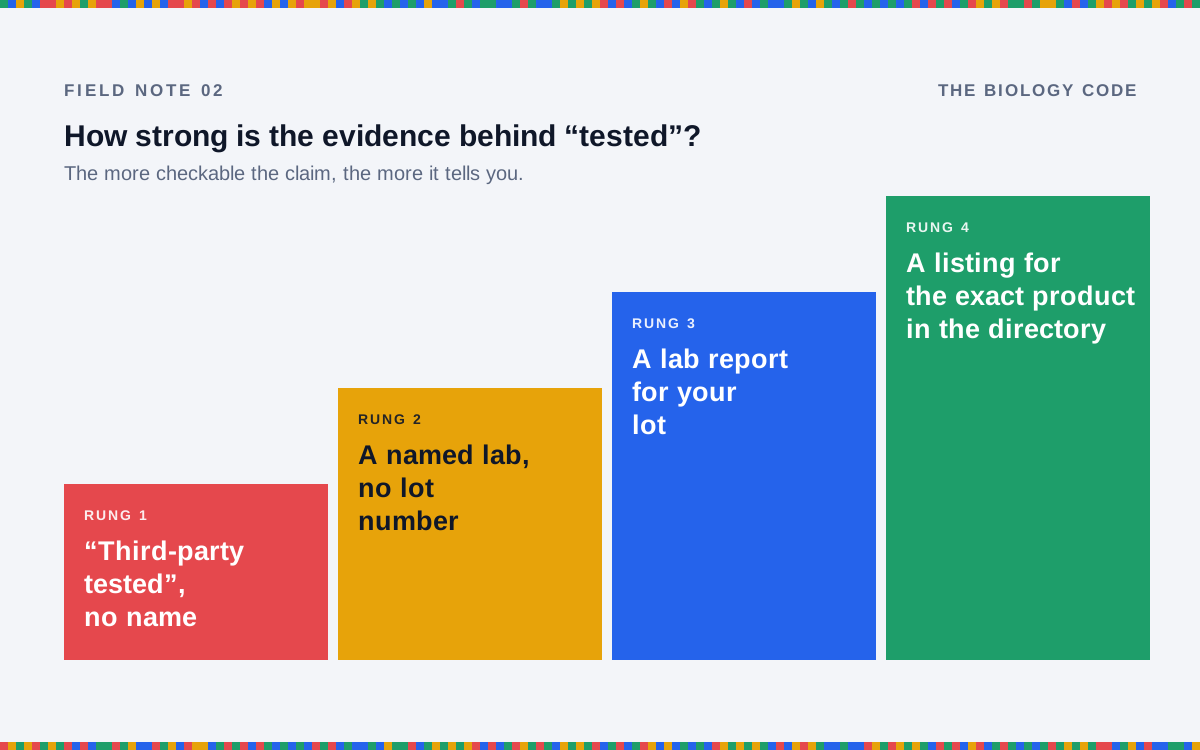
A rough ladder, from weakest to strongest evidence:
- “Third-party tested”, with no lab, method or certificate.
- A named lab, but no lot number and no method.
- A lab report for a specific lot, naming the method and the lab. ConsumerLab says to confirm it comes from an independent lab, covers the specific product (preferably the same lot) and uses an appropriate method, and it reports having seen lab reports with wrong methods, results from other products, and fabricated results.15
- A listing for the exact product in the certifier’s own public directory.
How to check a seal yourself
- Go to the certifier, not the seller. Use the directory in the table above, typed in yourself rather than reached from a link on the product page.
- Search the exact product name, and the lot or batch number where the directory supports it (NSF Certified for Sport, Informed Sport and Informed Choice do).
- Match what you find to what you hold: same product name, form, flavor or variant, and serving. Certification attaches to listed products, so a seal on one product says nothing about the same brand’s others.
- Check the type of listing. A certified raw ingredient is not a certified finished product.
- Check the date. NSF stamps its listing with a “current as of” date; ConsumerLab certifications last 24 months and lapsed ones may not bear the seal.9,14
A logo is not a listing. NSF itself warns about fraudulent copying and manipulation of website text and says to confirm on its site.9 If you cannot find the product in the directory, the honest reading is “not verified”, not “fake”: ask the seller which program, which product listing and which lot.
What a seal cannot tell you
- Whether it works. These programs ask whether the bottle matches the label and is free of specified contaminants or banned substances. They do not ask whether the ingredient does anything for you; NSF’s own page says it does not test for efficacy.9 A quality check and a human study answer different questions.
- Whether the dose is right for you. A label can be perfectly accurate about an amount that is too high, too low or simply unnecessary for your situation.
- Whether it is safe alongside your medicines. Consumer Reports, quoting a Harvard Medical School internist, noted that even a supplement certified to contain what its label says could still cause serious side effects.16 If you take prescription medicines or have a health condition, ask a pharmacist or clinician first.
- Everything that could be in it. A banned-substance screen covers a defined list, and the mark you are looking at may be a sports mark rather than a contents mark. Match the seal to your question.
- That an unsealed product is worse. Seals are voluntary and applied for by the maker. Many sound products carry none; the absence of a seal is missing evidence, not evidence of a problem.
How The Biology Code treats the T check
Every entry runs four checks. The red T asks whether there is independent lab or certification evidence, or only the seller’s say-so. We look for that evidence in the certifier’s own directory rather than taking a logo on the seller’s page at face value, and each entry states the date we looked, because directories change.
- Verified A named independent laboratory or certification program has tested or certified this specific product, and we could confirm it, ideally by finding the exact product in the certifier’s own public directory.
- Partial Some independent testing is shown but it is limited: it covers one ingredient or batch or only some SKUs, the seal appears on the seller’s page but we could not confirm the listing, or the program checks something narrower than a shopper might assume, such as a facility rather than the product, or random sampling rather than every batch.
- Not shown We found no verifiable third-party evidence. This describes what we could confirm, not the quality of the product.
T is one check of four: a product can be verified on T and still raise questions about actives, claims or guarantees. The entries listed beside this note show it applied.
Sources
- U.S. Food and Drug Administration. Small Entity Compliance Guide on the current Good Manufacturing Practice rule for dietary supplements (specifications, identity testing, finished-batch verification). FDA. link
- 21 CFR 111.1, who is subject to the dietary supplement GMP rule (text copy). Legal Information Institute, Cornell Law School. link
- U.S. Food and Drug Administration. Questions and answers on dietary supplements (no pre-market approval; manufacturer responsibility). FDA. link
- National Center for Complementary and Integrative Health. Using dietary supplements wisely. NIH. link
- US Pharmacist. Determining the quality of dietary supplements, November 20, 2020 (USP audit, seal use, NSF lot-by-lot sport analysis, USP verified-products directory). link
- Josh Long (an executive of the Natural Products Association trade group). A tribute to the USP Verified Mark for supplements, August 22, 2024. Supply Side Supplement Journal; the annual-testing point is a quote from a brand employee. link
- United States Pharmacopeia. What the USP Verified Mark means and how its process works, in USP’s own words: Quality-Supplements.org FAQ and “why it matters” page, and the usp.org Dietary Supplement Verification Program page. The live pages refused automated requests, so we read Internet Archive copies (captured December 2025 to January 2026). Also a verified brand’s page (Nature Made) repeating USP’s description. FAQ (archived copy read) · why it matters (archived copy read) · program page (archived copy read) · Nature Made
- United States Pharmacopeia (encyclopedia summary): the Verified Mark versus the letters “USP” on a label. Wikipedia. link
- NSF. Certified dietary supplements directory; the NSF/ANSI 173 listing page with its “current as of” date and warning about copied website text; and NSF’s consumer page on supplement and vitamin certification (the live page refused automated requests, so we read an Internet Archive copy captured December 29, 2025). directory · listing page · consumer page (archived copy read)
- Heather Davis. All about NSF: supplement certification and beyond, September 14, 2025. Today’s Dietitian. link
- NSF Certified for Sport. What the mark means; how certification works; certified product search; about NSF. mark · process · search · about
- Informed Sport (LGC). Certification process, science and testing, and FAQ. process · science · FAQ
- LGC. Informed Sport versus Informed Choice, and how Informed Choice works. comparison · Informed Choice
- ConsumerLab.com. About; Quality Certification Program; list of certified products. about · program · certified list
- ConsumerLab.com. Trusting certificates of analysis from supplement manufacturers; what to avoid with supplements. certificates · red flags
- Consumer Reports. How to choose supplements wisely, October 30, 2019 (quoting a Harvard Medical School internist on certified products and side effects). link
This article is educational and is not medical advice. Ask a qualified clinician before starting any supplement.