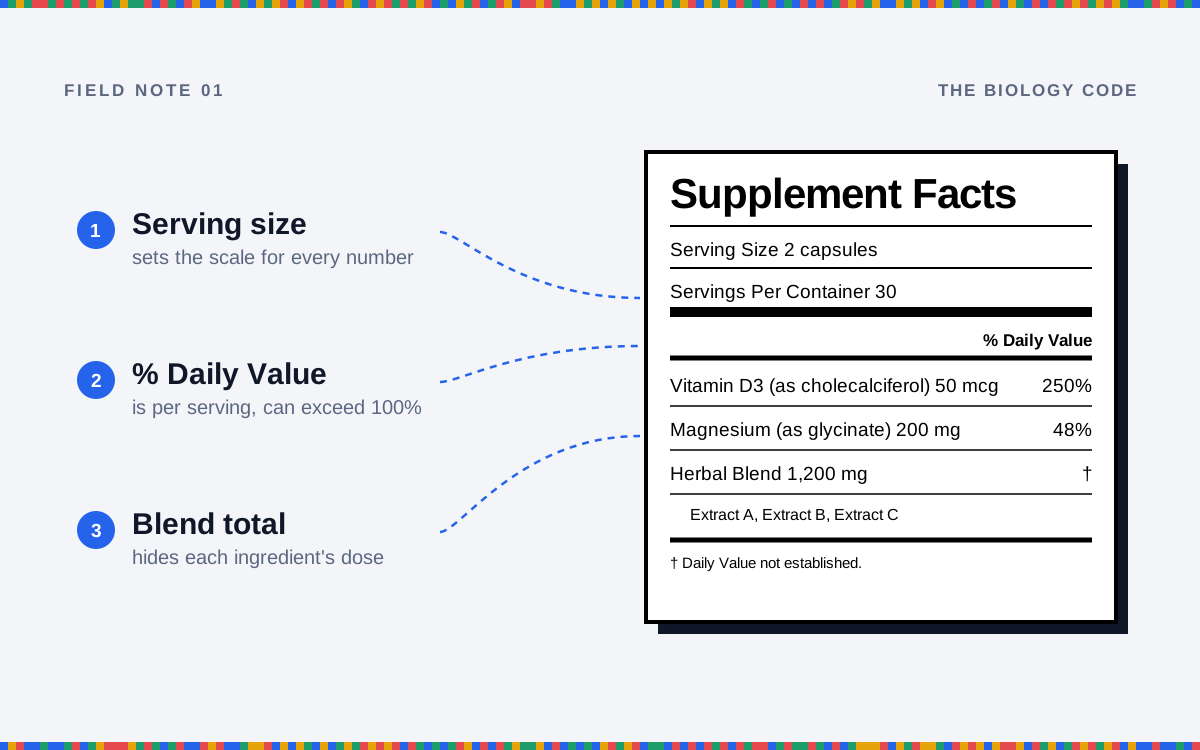
Dietary supplement labels are required to carry a Supplement Facts panel with a fixed layout.1 Read in the right order, a bottle takes a couple of minutes to decode: the serving, the amounts, the names, then any blend. This note follows that order and ends with what a label can never tell you.
Start with the numbers
Serving size and servings per container
The first two lines set the scale for everything below them. FDA’s labeling guide defines one serving as the maximum amount the label recommends per eating occasion or, with no recommendation, one unit such as a capsule; if the directions say to take one to three tablets with breakfast, the serving size is three.2 So a panel may describe the largest suggested amount, not the smallest. “Servings per container” is how many the package holds, which lets you work out the cost per serving and how long a bottle lasts.3
Amount per serving and % Daily Value
Each ingredient appears with a weight per serving, in milligrams (mg) or micrograms (mcg); one mg is 1,000 mcg. The % Daily Value (%DV) is that amount divided by the established Daily Value, times 100.2 Daily Values are reference amounts FDA sets for labeling; its table lists 20 mcg for vitamin D, 420 mg for magnesium and 11 mg for zinc.4 By default the percentages use the values for adults and children aged four and over.2
The formula has no ceiling at 100: 50 mcg of vitamin D against a 20 mcg reference amount prints as 250%, the figure on the panel in the illustration above. A high percentage says the serving is large relative to the reference amount, not whether it suits you. Safe upper limits are separate numbers, and the National Center for Complementary and Integrative Health (NCCIH) advises keeping total intake of vitamins and minerals, fortified foods included, within them.5 FDA’s rule of thumb: 5% or less per serving is low, 20% or more is high.4
Ingredients with no Daily Value, such as most botanicals, get a symbol such as a dagger or asterisk in the % column, pointing to the footnote “Daily Value not established.”3 It is not a warning. It means no reference amount exists, so you judge the amount against research instead.
Serving size is the multiplier. Before comparing two products, or a product with a study, put everything on the same footing: the amount per capsule, or the amount per day at the number of capsules you would really take.
How ingredients are named
A Supplement Facts panel differs from the Nutrition Facts panel on food in ways that help a reader: ingredients with no Daily Value must be listed, the source may be shown inside the panel, plant-derived ingredients must name the plant part, and zero amounts may not be listed.2
Take “Magnesium (as magnesium glycinate)”: the nutrient, then the compound that supplies it. The rule lets a maker name the source after “as” or “from,” and for a nutrient with a Daily Value the printed weight must be the nutrient itself, “the weight of calcium rather than that of calcium carbonate.”3 So 200 mg of magnesium (as magnesium glycinate) is 200 mg of magnesium inside a larger weight of compound. The %DV is a cross-check: 200 divided by 420 is about 48%. If the milligrams and the percentage do not reconcile, ask the seller.
For ingredients without a Daily Value, such as extracts, the printed weight is that of the ingredient listed “and not the weight of any component, or the source, of that dietary ingredient.”3 So an extract’s milligrams are the extract’s weight, not that of a compound inside it. Whether one form is absorbed better than another is a separate question, covered in our field note on nutrient forms and absorption.
Proprietary blends
Some panels group ingredients under “Proprietary Blend” or a brand-style name such as “Focus Matrix,” with one weight for the group; the rule allows “Proprietary Blend” or an “other appropriately descriptive term or fanciful name.”3 For the ingredients inside that have no Daily Value, the rule asks for two things about amounts: the weight shown is their total, and they are listed “in descending order of predominance by weight.” No separate amount for each is required.3 Vitamins and minerals inside a blend that do have a Daily Value are declared normally, with their own amounts.3
You can work out the total per serving and the order, and from those two facts, bounds: with n ingredients, the first-listed is at least the total divided by n and the last-listed is at most that. You cannot work out the amount of any single ingredient (the first-listed could be nearly the whole total) or whether it matches the amount used in a study.
Here is an invented panel to practice on; it is not a real product. (The illustration above and the home page show a different made-up label.)
Invented panel for practice, not a real product.
Reading it in order: three capsules per serving and 30 servings make 90 capsules, and one capsule a day supplies a third of every figure. Magnesium at 84 mg is 20% of a 420 mg reference amount; zinc at 11 mg is 100% of 11 mg. The parentheses name sources, and the milligrams are the nutrients. Three ingredients share 900 mg per serving, so A is at least 300 mg and C is at most 300 mg. Beyond that the panel is silent: A could be 890 mg with B and C sharing the last 10.
A total is not a dose. However prominently a box features Ingredient C, one serving here holds at most 300 mg of it and possibly far less. Ask where the ingredient you care about sits in the list, and whether the seller states its amount anywhere else. It is why our Actives check asks of every entry: are the doses shown, or hidden in a blend?
Other ingredients
Below the panel sits the ingredient statement. It begins with “Ingredients,” except that “Other Ingredients” is used when some ingredients were named as sources inside the panel, and those need not be repeated.6 It runs heaviest first and covers what FDA’s guide calls binders, colors, excipients, fillers, flavors and sweeteners.6 In practice that is where you find the capsule shell, flow agents that keep powder from clumping, bulking fillers and sweeteners. There are no amounts, but the order shows which ingredient weighs more.
Allergen rules apply to supplements too.7 The nine major food allergens (milk, eggs, fish, Crustacean shellfish, tree nuts, peanuts, wheat, soybeans and sesame) must be declared either in parentheses in the list (“lecithin (soy)”) or in a “Contains” statement beside it.7 For anything outside those nine, read the list itself and ask the maker if unsure.
Claims, the FDA disclaimer and approval
A front-panel line such as “supports bone strength” is a structure/function claim: a statement about the role of a nutrient or ingredient in the body’s normal structure or function. FDA’s own examples are “calcium builds strong bones” and “fiber maintains bowel regularity.”8 FDA does not pre-approve these claims. The maker must ensure they are truthful and not misleading, and must notify FDA within 30 days of marketing the product with the claim.810 The claim must carry a disclaimer whose wording is fixed by regulation:
This statement has not been evaluated by the Food and Drug Administration…
A second mandated sentence says, in short, that the product is not intended to diagnose, treat or prevent disease; the exact wording is in 21 CFR 101.93.10 With several claims the first sentence becomes “These statements have not been evaluated…” The wording may not be changed, must be in boldface at least one-sixteenth of an inch high, and sits beside the claim or is tied to it by a symbol such as an asterisk.910 Three takeaways:
- It describes a process, not a verdict. FDA has not reviewed the claim. That does not make the claim wrong.
- A structure/function claim cannot name a disease. It may not link an effect, explicitly or implicitly, to a disease or a state leading to one.8 Generally, a product intended to treat or prevent disease is regulated as a drug, even if it is labeled as a supplement.1
- FDA does not approve supplements before they are sold. In FDA’s words, it “does NOT have the authority to approve dietary supplements for safety and effectiveness, or to approve their labeling, before the supplements are sold to the public.” Companies are responsible for safety, and FDA can act against an adulterated or misbranded product once it is on the market.111 Wording that suggests FDA endorsed a particular supplement is marketing, not regulation.
GMP statements, dates and storage
“Made in a GMP facility”
GMP is good manufacturing practice. For supplements the legal version is 21 CFR part 111, which applies to anyone who manufactures, packages, labels or holds one.13 FDA describes the aim as a product that consistently meets its specifications for identity, purity, strength and composition, with limits on contaminants; the rule includes verifying that a sample of finished batches meets them.14 So the phrase means the seller says it follows manufacturing rules that apply by law. It is not a seal, a score or an FDA approval. It does not say whether an outside party checked the finished product against its label, and since every firm in scope must comply, it cannot separate one product from another. NCCIH cautions that a maker’s use of “standardized,” “verified” or “certified” does not necessarily guarantee quality or consistency.12 What does differ is whether a named independent program lists the product in its own public directory; see what third-party testing seals mean.
Dates
FDA’s compliance guide says the rule does not require an expiration, shelf or “best if used by” date, but that a firm using one should have data to support it.14 A date is therefore the seller’s own statement, backed by evidence you cannot see. Use it if it is there; its absence is not a verdict.
Storage
Follow any storage directions printed on the label; NCCIH advises following label instructions.12 The manufacturing rule makes firms hold product under conditions of temperature, humidity and light that protect its identity, purity, strength and composition.15 That covers firms, not your kitchen, but the same three factors are a sensible guide for a cupboard (our inference, not an FDA instruction to consumers). Keep bottles away from children: tablets and capsules sold as an iron source must carry a boxed warning that accidental overdose is a leading cause of fatal poisoning in children under six.16
Five questions to ask of any label
- What is one serving, and how many will I take? Convert every figure to what you would take per day.
- Does each ingredient show its own amount, and is it the nutrient itself? Look for “(as …)”, check milligrams against %DV where one exists, and note every dagger.
- What sits inside a blend? Find the totals, count the ingredients, apply the divide-by-n bounds, and see where the ingredient the sales page talks about falls.
- What else is in it? Read “Other ingredients,” any “Contains” statement and any boxed warning.
- Who is vouching for it, and how? A claim should carry the FDA disclaimer and name no disease. A facility statement is the seller’s own; a named independent program is something you can look up. The label must also name the manufacturer, packer or distributor and its place of business, so check which one it is.17
A label can only tell you what the seller states. As NCCIH puts it, “What’s on the label may not be what’s in the product.”12 If you take prescription medicines or have a medical condition, ask a clinician or pharmacist before starting any supplement.
Sources
- U.S. Food and Drug Administration. FDA 101: Dietary Supplements. Consumer update on what FDA can and cannot do before a supplement is sold and on the Supplement Facts label. link
- U.S. Food and Drug Administration. Dietary Supplement Labeling Guide, Chapter IV: Nutrition Labeling. Question-and-answer guidance on serving size, % Daily Value and the Supplement Facts panel. link
- Code of Federal Regulations, 21 CFR 101.36, nutrition labeling of dietary supplements. Regulation text as published by the Cornell Legal Information Institute. link
- U.S. Food and Drug Administration. Daily Value on the Nutrition and Supplement Facts Labels. Definitions, the 5% and 20% guide, and the table of Daily Values. link
- National Center for Complementary and Integrative Health (NIH). Vitamins and Minerals. Guidance on safe upper limits and total intake. link
- U.S. Food and Drug Administration. Dietary Supplement Labeling Guide, Chapter V: Ingredient Labeling. The “Ingredients” and “Other Ingredients” statement. link
- U.S. Food and Drug Administration. Food Allergies. How allergen labeling rules apply to packaged foods including dietary supplements, and the nine major allergens. link
- U.S. Food and Drug Administration. Label Claims for Conventional Foods and Dietary Supplements. Structure/function claims and how they differ from health claims. link
- U.S. Food and Drug Administration. Dietary Supplement Labeling Guide, Chapter VI: Claims. Disclaimer wording, placement and type size. link
- Code of Federal Regulations, 21 CFR 101.93, certain types of statements for dietary supplements. The 30-day notification and the disclaimer requirements, as published by the Cornell Legal Information Institute. link
- U.S. Food and Drug Administration. Dietary Supplements. Overview of FDA’s regulatory role, including action after a product is marketed. link
- National Center for Complementary and Integrative Health (NIH). Using Dietary Supplements Wisely. Federal regulation, label accuracy and quality terms. link
- Code of Federal Regulations, 21 CFR 111.1, who is subject to the dietary supplement manufacturing rule. Regulation text as published by the Cornell Legal Information Institute. link
- U.S. Food and Drug Administration. Small Entity Compliance Guide: Current Good Manufacturing Practice in Manufacturing, Packaging, Labeling, or Holding Operations for Dietary Supplements. Covers the definition of quality, finished-batch verification and expiration dating. link
- Code of Federal Regulations, 21 CFR 111.455, holding requirements for dietary supplements. Regulation text as published by the Cornell Legal Information Institute. link
- U.S. Food and Drug Administration. Dietary Supplement Labeling Guide, Chapter VIII: Other Labeling Information. The required warning for iron-containing supplements. link
- U.S. Food and Drug Administration. Dietary Supplement Labeling Guide, Chapter I: General Dietary Supplement Labeling. Information panel contents and name and place of business. link
This article is educational and is not medical advice. Ask a qualified clinician before starting any supplement.